



























Why Does a Word-for-Word Translation Often Sound Wrong?

Table of Contents
- Summary
- 1. Why Literal Translation Does Not Actually Translate Meaning
- 2. How Professional Translation Services Go Beyond Words
- 3. Real-World Scenario: When a Literal Translation Creates Serious Problems
- 4. Myth vs. Reality: Common Misconceptions About Translation Accuracy
- 5. Translation Quality Checklist: When Word-for-Word Is Not Enough
- 6. Conclusion
- 7. Key Takeaways
Summary
Have you ever read a translation that was technically understandable but still sounded strangely wrong? This happens when words are replaced individually without considering the meaning of the complete message. Literal translation can create confusion in immigration documents, business contracts, medical records, websites, and international communications. Understanding why context matters can help individuals and organizations avoid costly mistakes, delays, misunderstandings, and damage to their credibility.
Matching words does not guarantee matching meaning. Translation requires an understanding of context, tone, purpose, culture, and the intended audience.
A word-for-word translation may reproduce the vocabulary of the original document while completely changing or obscuring its message.
Key Insight: Accurate translation preserves the complete meaning of a message, not merely the individual words.
Why Literal Translation Does Not Actually Translate Meaning
Many people assume that translation is a simple process of replacing each word in one language with its closest equivalent in another.
Languages do not work that way.
Every language has its own grammar, sentence structure, expressions, cultural references, and ways of communicating formality, emotion, and intent. A sentence that sounds completely natural in one language may sound confusing or even ridiculous when translated word for word.
Consider the Spanish expression:
“Me cayó el veinte.”
A literal English translation would be something like:
“The twenty fell on me.”
The individual words have been translated, but the actual meaning has disappeared.
A natural English translation would be:
“It finally clicked.”
or:
“I finally understood.”
The correct version depends on the context and the speaker’s tone.
English contains the same type of expressions.
“Please bear with us” does not involve an animal.
“Break a leg” is not a request for someone to become injured.
“A piece of cake” does not always refer to food.
These expressions communicate ideas that cannot be understood by looking at each word separately.
Literal translation also causes problems because many words have several meanings.
The English word “party,” for example, may refer to a celebration or to an individual or organization involved in a contract.
“Charge” may describe a fee, a criminal allegation, electrical energy, or the act of assigning responsibility.
“Consideration” may refer to careful thought in everyday language, but in a legal agreement it may describe something of value exchanged between the parties.
Choosing the wrong meaning can change the entire message.
Professional translators do not ask only, “What does this word mean?”
They also ask:
- What does it mean in this sentence?
- What kind of document is this?
- Who will read it?
- What result is the writer trying to achieve?
The goal is not to reproduce isolated words mechanically. It is to communicate the same meaning naturally and accurately in the target language.
How Professional Translation Services Go Beyond Words
Professional translators do much more than convert vocabulary from one language into another.
They are trained to analyze context, identify the purpose of a document, research specialized terminology, preserve tone, and write naturally for the intended audience.
For example, the English expression “please bear with us” means “please be patient.”
A professional translator will recognize that it is an idiomatic expression and choose wording that communicates patience naturally in the target language.
A literal translation could produce a sentence that is confusing or unintentionally humorous.
This distinction becomes especially important in law, medicine, immigration, finance, and business.
A legal phrase may carry a specific meaning that is different from its everyday use.
A medical term may describe a condition, procedure, or symptom with no room for approximation.
An immigration document must preserve names, dates, relationships, official titles, and visible annotations accurately.
A business message must sound professional and credible to the intended market.
Professional translation services normally involve several stages.
The translator first reviews the complete document rather than translating disconnected sentences.
They identify the audience, purpose, subject matter, and destination country.
They research specialized terminology and establish consistent wording for recurring concepts.
They then produce a translation that preserves the original meaning while following the grammar and writing conventions of the target language.
The translation is also edited and proofread.
Important details such as names, dates, addresses, numbers, headings, tables, signatures, seals, and formatting are checked carefully.
For high-risk documents, a second qualified linguist may compare the translation against the source.
Professional translators distinguish between accuracy and literalness.
Accuracy means preserving the facts, meaning, tone, and intent of the original.
Literalness means following the original words and structure closely, even when the result sounds unnatural.
The most accurate translation is not always the most literal translation.
A reliable translation should feel as though it was originally written in the target language while still remaining faithful to the source.
Key Insight: Natural wording must still preserve every fact, instruction, obligation, and detail in the original document.
Real-World Scenario: When a Literal Translation Creates Serious Problems
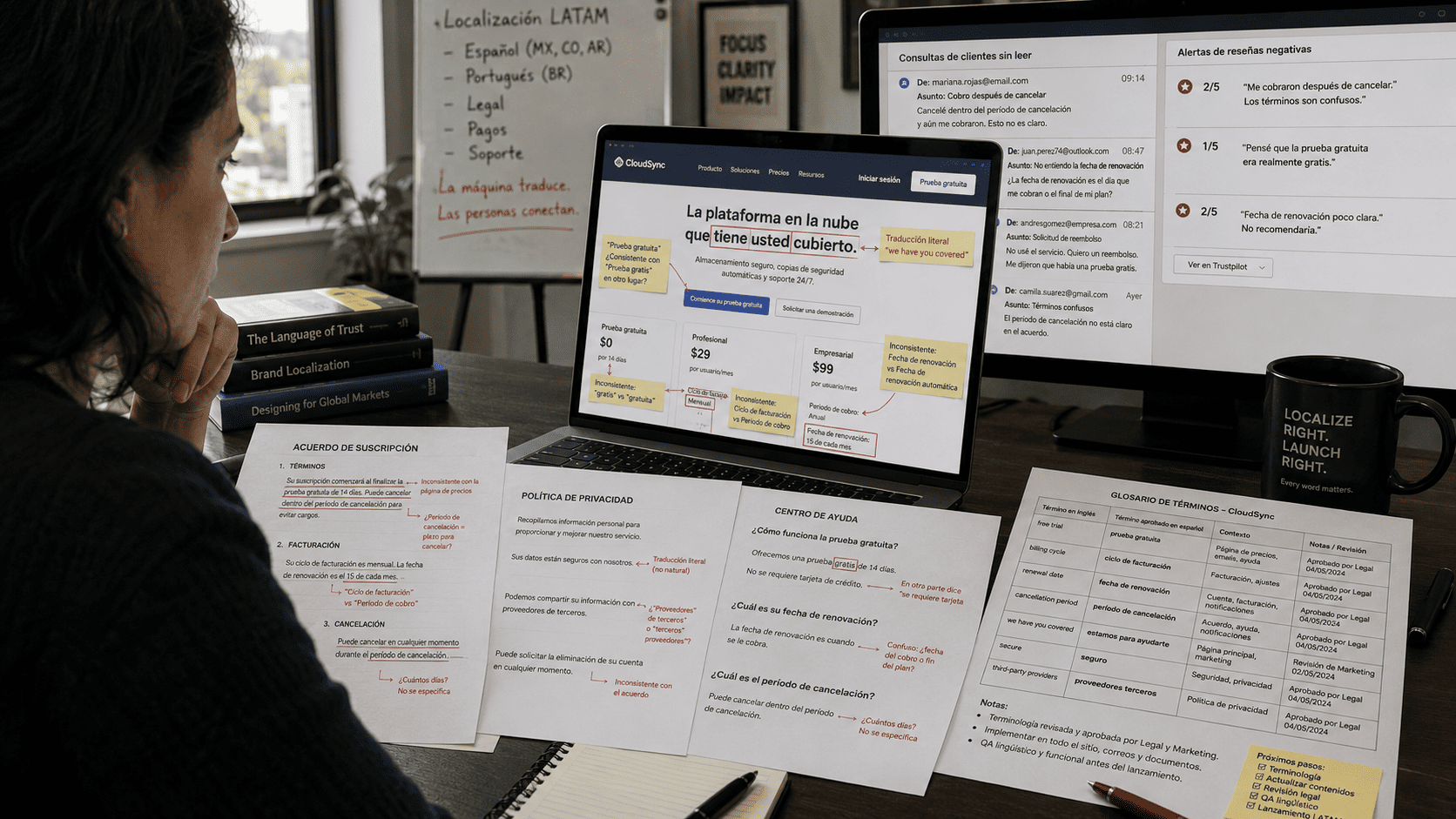
Consider a U.S. software company preparing to expand into several Latin American countries.
The company needs Spanish versions of its website, subscription agreement, privacy policy, product instructions, and customer-support messages.
To reduce costs, the company uses machine translation and asks a bilingual employee to review the results quickly.
At first, the translations appear acceptable.
Most of the sentences are understandable, and the Spanish version contains words that seem related to the English source.
Problems begin after the product launches.
The phrase “free trial” is translated in a way that suggests the entire service is permanently free.
A section describing how the company processes personal data uses a Spanish word associated with industrial manufacturing instead of data handling.
The contract translates “termination for cause” as if either party can cancel the agreement without a reason.
The customer-support phrase “we have you covered” is translated literally, producing wording that sounds as though the company has physically placed something over the customer.
The terms “billing cycle,” “renewal date,” and “cancellation period” are also translated differently across the website and contract.
Customers no longer understand when they will be charged or when they can cancel.
Some believe that the Spanish agreement gives them rights that are not included in the English version.
Others complain that the company’s website sounds unprofessional and difficult to trust.
The company now faces refund requests, negative reviews, increased customer-support volume, and concerns from local business partners.
It must hire professional translators to review every page, update the contracts, correct the website, notify customers, and retrain the support team.
The original machine translation appeared inexpensive.
The corrective work is not.
Now consider what would have happened with a professional translation process.
The company would first identify the target countries and audiences.
Legal documents would be assigned to translators with legal experience.
Marketing content would be adapted for the local market rather than translated mechanically.
A terminology glossary would establish approved wording for billing, privacy, renewal, cancellation, and subscription terms.
Translators would receive screenshots and context so they could see where each phrase appeared.
A second linguist would review the final content, and native-speaking users would test the localized website before launch.
The result would not simply sound better.
It would reduce confusion, support legal consistency, build trust, and make the company easier to do business with.
Key Points:
- Literal translation can change contractual, financial, and operational meaning.
- Inconsistent terminology can confuse customers and create legal risks.
- Professional translation reduces corrective costs and protects brand credibility.
Myth vs. Reality: Common Misconceptions About Translation Accuracy
Myth: Every word has one exact equivalent
Reality: Most words have several possible meanings.
The correct choice depends on the sentence, subject matter, tone, and intended audience.
A dictionary may provide several valid translations, but only one may communicate the right meaning in a specific context.
Myth: A literal translation is always more accurate
Reality: Literal wording may preserve the original sentence structure while changing the message.
Accuracy requires the translator to preserve meaning, facts, tone, and purpose.
This may require different wording or sentence structure in the target language.
Myth: Anyone who speaks two languages can translate professionally
Reality: Speaking two languages does not automatically provide the skills required for professional translation.
Translators must be able to research terminology, identify ambiguity, write naturally, preserve meaning, maintain consistency, and follow the conventions of specialized fields.
A bilingual person may understand a contract without knowing how its legal terminology should be translated.
A bilingual healthcare worker may understand a diagnosis without being trained to translate medical records accurately.
Myth: Machine translation is good enough for short documents
Reality: Short text can be especially difficult because it contains less context.
A warning, form field, diagnosis, contract clause, or website button may consist of only a few words, but choosing the wrong meaning can still create serious problems.
Machine translation may support general understanding, but important content requires professional review.
Myth: If a translation sounds fluent, it must be accurate
Reality: A translation can sound natural while containing serious mistakes.
It may change a date, omit a negative word, alter a legal obligation, confuse two family relationships, or replace a technical term with an everyday expression.
Fluency should never replace source-to-target verification.
Myth: Certified translation means literal translation
Reality: A certified translation must be complete and accurate, but it does not need to imitate unnatural source-language grammar.
The translator should preserve the meaning faithfully while producing clear target-language text.
Seals, signatures, stamps, handwritten notes, and unclear sections should be represented transparently.
Myth: Professional translation is necessary only for legal documents
Reality: Professional translation is valuable whenever an error could affect money, safety, compliance, reputation, or customer trust.
This includes websites, medical information, product instructions, business proposals, financial materials, software, advertising, and employee training.
Translation Quality Checklist: When Word-for-Word Is Not Enough
Before approving a translation, evaluate whether it communicates the same message as the original.
Do not look only for matching words.
1. Review the complete message
Read the translation as a complete document and ask whether it sounds natural in the target language.
2. Check idioms and special expressions
Confirm that idioms and special expressions have been translated according to their meaning.
A phrase that sounds ordinary in one country may sound confusing, inappropriate, or humorous in another.
3. Review specialized terminology
Legal, medical, financial, academic, engineering, and immigration documents often contain specialized terms that must remain consistent.
The same concept should not receive several unrelated translations unless the context requires a change.
4. Confirm names, dates, and numbers
Names should appear consistently throughout the document.
Dates should be checked carefully when the source and target countries use different formats.
Addresses, percentages, measurements, monetary amounts, identification numbers, and case numbers should receive separate verification.
5. Review the tone
A legal notice should not become casual.
A compassionate healthcare message should not become cold or threatening.
A professional business proposal should not sound robotic.
A marketing message may require cultural adaptation while preserving the original claim.
6. Check for omitted or added information
A translator should not remove difficult sentences, summarize content, silently correct facts, or add explanations that do not appear in the source.
When text is illegible or unclear, the translation should identify that limitation instead of inventing a likely meaning.
7. Inspect the formatting
Headings, tables, footnotes, checkboxes, handwritten notes, signatures, seals, stamps, and annotations may all contain relevant information.
A complete translation should account for the full visible document, not only the main paragraphs.
8. Complete a source-to-target review
Have a qualified reviewer compare the translation directly against the original.
Proofreading only the target text can identify spelling and grammar problems, but it may not reveal missing information or changes in meaning.
Source-to-target review is especially important for legal agreements, immigration documents, medical records, court filings, and certified translations.
9. Match the process to the document’s intended use
A document submitted to USCIS may require a certificate of accuracy.
A contract may require a legal translator.
A medical document may require specialized medical knowledge.
A website may require localization and testing after the translated text is added to the design.
The more serious the consequences of an error, the more rigorous the translation process should be.
Conclusion
Translation is not the mechanical replacement of words from one language with words from another.
Meaning depends on context, culture, grammar, tone, audience, and subject matter.
A word-for-word translation may appear faithful while producing language that is awkward, confusing, misleading, or completely incorrect.
For casual understanding, a literal translation may occasionally be sufficient.
For immigration filings, contracts, medical documents, websites, business communications, and official records, the consequences of an error are much greater.
Professional translation services preserve the original message while ensuring that the final text sounds clear and natural to the intended reader.
The Spanish Group is a renowned translation company offering services in over 90 languages. No matter the subject or document type, our experts are trained and certified to deliver the highest-quality translations.
Send your document to The Spanish Group for professional translation, terminology review, and quality assurance.
The goal is not simply to translate every word. It is to ensure that the complete message is understood exactly as intended.
Key Takeaways
- Word-for-word translation often loses context and meaning.
- Fluent language is not always accurate.
- Specialized documents require subject-matter expertise.
- Professional review prevents costly misunderstandings.