




























Why Healthcare Organizations Are Increasingly Relying on Document Translation Services

Table of Contents
-
- 1. Summary
- 2. Why Healthcare Needs Translation More Than Ever
- 3. The Real Cost of Miscommunication in Medical Settings
- 4. How Spanish Document Translation Supports Patient Safety
- 5. Real-World Scenario: When Translation Errors Impact Care
- 6. Compliance, Risk, and Operational Efficiency
- 7. Conclusion
- 8. Key Takeaways
- 9. FAQ
Summary
Healthcare organizations in the United States are serving more multilingual patients than ever—especially Spanish-speaking communities. This makes spanish document translation a critical part of healthcare operations. From intake forms to discharge instructions, translation errors can directly affect patient outcomes and legal compliance. This article explains why hospitals are investing in professional translation services and how accurate communication improves safety, trust, and operational efficiency.
Why Healthcare Needs Translation More Than Ever
Hospitals in the United States are facing a growing challenge: a significant portion of patients have limited English proficiency.
Spanish-speaking patients represent one of the largest language groups requiring support, which creates an urgent need for reliable spanish document translation across healthcare systems.
However, this is not only a communication issue—it is also a patient safety and compliance issue.
Federal regulations require healthcare providers receiving public funding to ensure meaningful access to care for patients with Limited English Proficiency (LEP).
This means hospitals must ensure patients fully understand:
- Consent forms
- Diagnoses and treatment plans
- Medication instructions
- Discharge instructions
- Insurance and billing documents
This is where spanish document translation services become essential.
Healthcare organizations cannot rely on bilingual staff without certification or automated translation tools. These methods often fail to ensure accuracy, consistency, and clinical precision.
Even small translation errors can lead to serious consequences:
- Incorrect medication usage
- Misunderstood discharge instructions
- Missed follow-up care
- Increased hospital readmissions
- Potential legal and compliance risks
In healthcare, communication is directly tied to patient safety.
The Real Cost of Miscommunication in Medical Settings
Miscommunication in healthcare is not just inconvenient—it is costly and potentially dangerous.
When translation is inaccurate, risks increase across every stage of patient care.
Poor translation can lead to:
- Higher hospital readmission rates
- Medication errors due to misunderstood instructions
- Delayed recovery
- Regulatory compliance violations
- Legal exposure and malpractice risk
Research from the Agency for Healthcare Research and Quality (AHRQ) confirms that language barriers significantly increase the risk of adverse medical events and reduce patient comprehension.
This is why healthcare organizations are increasingly investing in translation services spanish to english and english to spanish document translation services.
These services ensure:
- Accurate medical terminology
- Clear patient instructions
- Consistent clinical documentation
- Improved communication between providers and patients
Without professional translation, even minor misunderstandings can escalate into major clinical issues.
In healthcare, small errors rarely stay small.
How Spanish Document Translation Supports Patient Safety
Accurate spanish document translation services play a direct role in improving patient safety and healthcare outcomes.
Hospitals rely on translated documents across multiple departments, including emergency care, surgery, oncology, pediatrics, and primary care.
Common documents requiring translation include:
- Patient intake forms
- Consent forms
- Laboratory results
- Prescription instructions
- Discharge summaries
- Medical history questionnaires
Each document directly influences clinical decision-making and must be translated with precision.
Why professional translation matters:
- Ensures correct medical terminology.
- Reduces risk of clinical errors.
- Improves patient adherence to treatment.
- Supports regulatory compliance.
- Enhances provider–patient communication.
Many healthcare systems are now integrating english to spanish document translation services directly into electronic health record (EHR) systems to ensure consistency and reduce human error.
This reflects an important shift in healthcare:
Communication is now part of treatment, not just documentation.
Real-World Scenario: When Translation Errors Impact Care
Consider a common hospital scenario.
A Spanish-speaking patient is discharged after surgery. Instead of using professional spanish document translation services, the hospital relies on automated translation.
The English discharge instruction reads:
“Take one tablet every 6 hours as needed for pain.”
However, the Spanish version incorrectly states:
“Take one tablet only when pain becomes severe.”
At first glance, the difference seems minor.
In reality, it completely changes the treatment plan.
What happens next:
-
- The patient under-treats pain.
- Recovery is delayed.
- Symptoms worsen.
- The patient returns to emergency care.
Impact on the hospital:
- Increased readmission costs.
- Higher operational burden.
- Potential legal exposure.
- Reduced patient trust.
How it could have been prevented:
Professional translation services spanish to english would have ensured:
- Clinical terminology accuracy.
- Certified translation review.
- Standardized medical formatting.
- Quality assurance checks before discharge.
Providers like The Spanish Group help prevent these risks by ensuring accurate, certified medical translations across more than 90 languages.
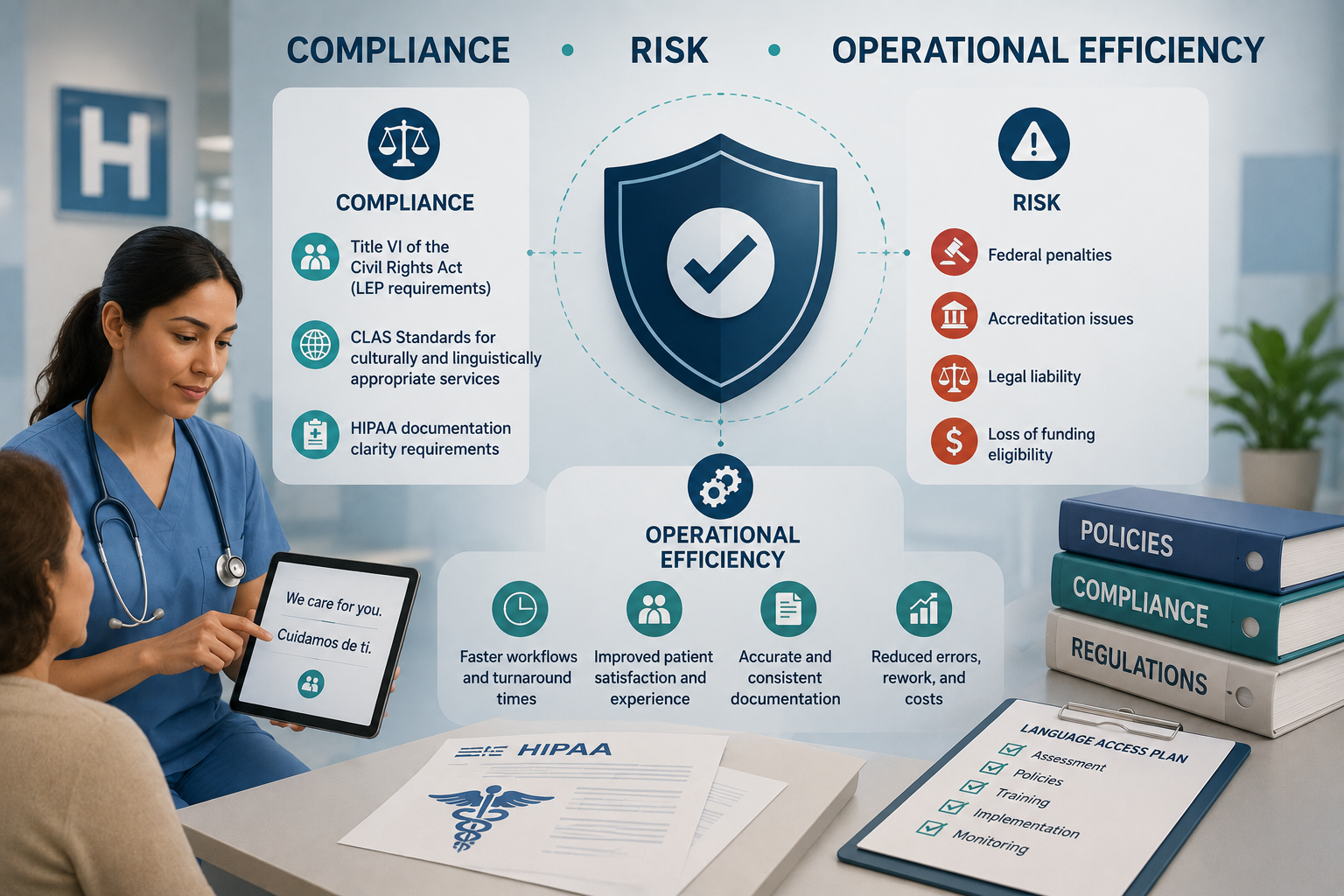
Compliance, Risk, and Operational Efficiency
Healthcare organizations are not adopting translation services only for patient experience—they are also driven by compliance and operational efficiency.
Key regulations include:
- Title VI of the Civil Rights Act (LEP requirements).
- CLAS Standards for culturally and linguistically appropriate services.
- HIPAA documentation clarity requirements.
Failure to comply can result in:
- Federal penalties.
- Accreditation issues.
- Legal liability.
- Loss of funding eligibility.
Operational benefits of professional translation:
- Faster patient intake and discharge processes.
- Fewer documentation errors.
- Improved clinical workflow efficiency.
- Higher patient satisfaction.
- Reduced readmissions due to misunderstanding.
This is why spanish document translation services are becoming a core operational function in healthcare systems—not an optional service.
Hospitals are now treating translation as essential infrastructure, similar to diagnostics or electronic health records.
Because in healthcare, clarity equals safety.
Conclusion
Healthcare organizations are increasingly relying on spanish document translation because communication directly impacts patient safety, regulatory compliance, and operational efficiency. As the U.S. healthcare system becomes more linguistically diverse, accurate translation is no longer optional—it is essential.
Errors in medical translation can lead to misdiagnosis, improper treatment, and legal consequences. This is why hospitals are investing heavily in spanish document translation services, translation services spanish to english, and english to spanish document translation services to ensure clarity and consistency across all patient communication.
Providers like The Spanish Group play a key role in this transformation by offering certified, accurate translations in over 90 languages. In modern healthcare, clear communication is not just helpful—it is critical for patient safety and trust.
Key Takeaways
- Spanish translation is essential for patient safety.
- Miscommunication increases clinical and legal risk.
- Certified translation ensures compliance and accuracy.
- Healthcare systems depend on professional language services.