



























The Mega Linguistic Challenge of the 2026 World Cup: Why Real-Time Translation Will Define Global Success
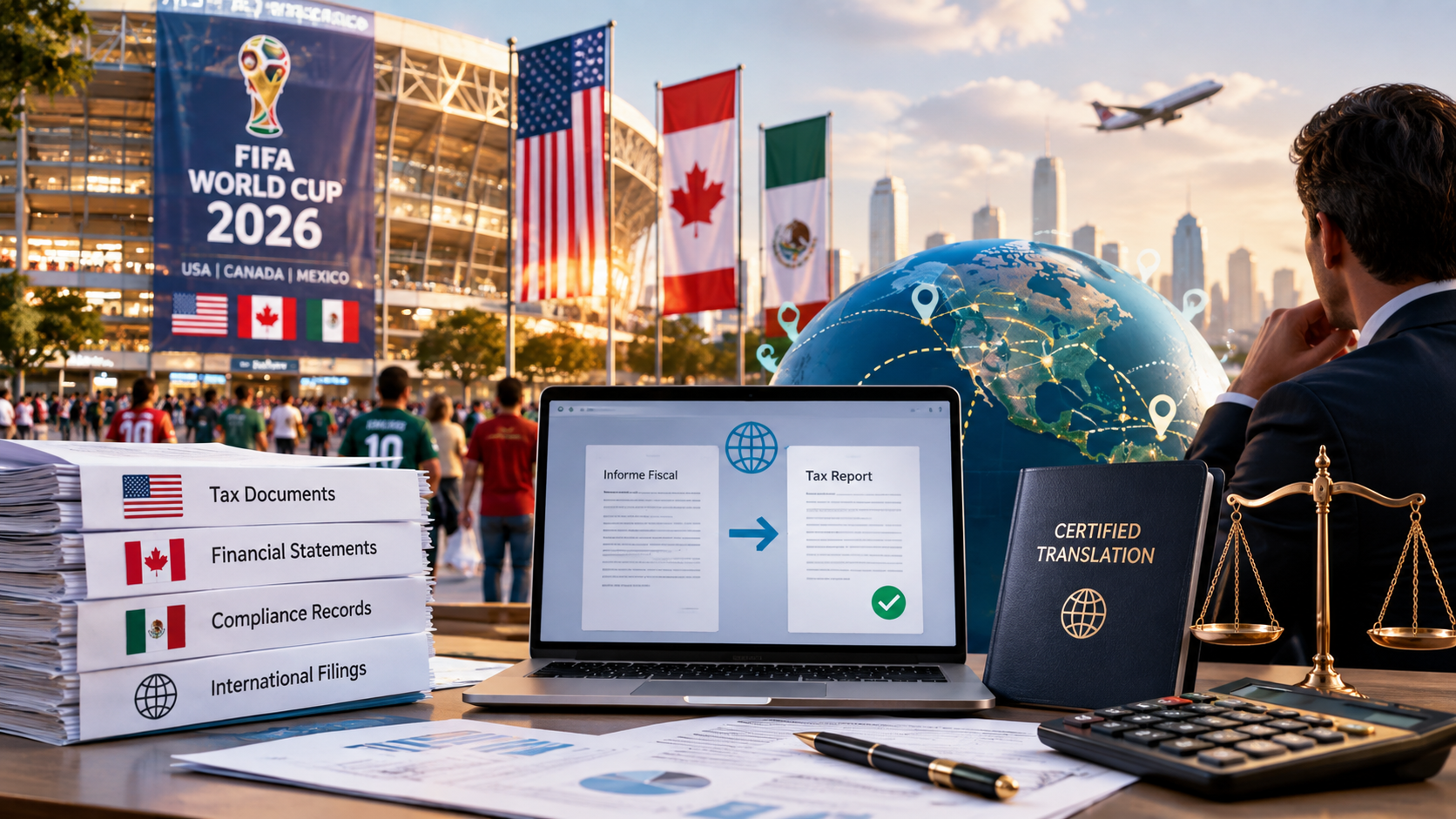
Table of Contents
- Summary
- 1.The Scale of the 2026 World Cup Linguistic Challenge
- 2.Why Translation Failures Create Legal and Financial Risk
- 3.Real-World Scenario: When Translation Errors Cost Millions
- 4.How Certified Translations Protect Tax and Legal Compliance
- 5.Building a Scalable Translation Strategy for Global Events
- 6.The Business Opportunity Behind Multilingual Demand
- Conclusion
- Key Takeaways
- FAQ´s
Summary
What would it look like if three nations, thousands of tourists, and multiple vehicles all interacted simultaneously? This results not only in operational complexity, but it also creates a high-risk scenario, where lack of communication can result in lost revenues, compliance issues and missed business opportunities. As we prepare for the 2026 World Cup, companies that do not prepare for multi-lingual demands will be left behind in a globalized and regulated environment.Shape
1.The Scale of the 2026 World Cup Linguistic Challenge
The 2026 FIFA World Cup will be the biggest event in the history of the World Cup, taking place in the United States of America, Canada, and Mexico. Around the world, it is expected to attract millions of spectators and participants. The event is a sports spectacle, but it will also affect businesses, and drive cross-border commerce, and increase financial transactions, and document processing, due to the international nature of many documents that will need to be translated into multiple languages and legal processes.
As a result of these events, accounting firms and other financial professionals will face the challenge of having to manage operations and clients that are in different countries, all submitting tax records, financial statements, and compliance material to them in their native languages. To ensure that all of these documents are translated accurately, and in accordance with the relevant regulatory requirements, there will be a reliance on certified tax document translation services to ensure that all of the documents are correctly interpreted and are legally acceptable.
There will also be a significant increase in the demand for international tax compliance translations. Many businesses that operate across borders will have to comply with various tax jurisdictions that have different terminology, reporting requirements, and legal definitions. If translation is not accurate, a well-prepared financial report can result in the client being liable for noncompliance.
Moreover, the amount of tax return translations will grow as people and companies deal with international income taxes. Because of how complicated these filings can be, there is very little room to make mistakes; therefore, having a good professional translator becomes very important. In this manner, translation is more than just a language service; it is an integral element of financial accuracy and compliance.
2.Why Translation Failures Create Legal and Financial Risk
Errors in translation can have significant repercussions, particularly when working in high-pressure settings like the World Cup. This is true in many accounting-related situations, as the accuracy demanded by financial and legal documents is extreme. Even a single incorrectly-translated item can lead to serious problems. In the case of accounting firms, the legal risks associated with poorly-translated documents are a major concern because of their direct relation to compliance with regulations and client outcomes.
For example, an incorrectly translated amount may result in the incorrect tax return being filed. This will cause a client to undergo an audit, face penalties, or become involved in a legal dispute. The IRS and other regulatory agencies require total and complete accuracy when it receives submitted documents. If a client submits inaccurate documents (even if the inaccuracy was unintentional), it may cause a costly tax audit to occur.
The risk of having translated documents processed for compliance, especially during global events, is compounded by the frequency and urgency with which documents need to be processed. High volumes and tight timeframes mean that if adequate systems are not in place, the likelihood of having an error occur is very large. Therefore, relying on automated tools or on non-certified translations to produce a translated document may appear efficient; however, they usually result in inconsistencies that result from lack of compliance.
When creating translated documents for compliance with legal requirements, the use of certified translations provides protection against the risks involved. Certified translations ensure that each document has been translated by a translator who is competent in both the target language and the applicable regulatory standards. It is critical that this level of accuracy be maintained in order to preserve the confidence of clients and avoid unwarranted legal liability.
The American Translators Association indicates that a certified translation of legal and financial documents is essential for ensuring accurate and accountable documentation. Businesses engaged in the global marketplace view this as an essential part of their operation.

3.Real-World Scenario: When Translation Errors Cost Millions
To understand how translation mistakes can affect a business; for example, during the World Cup in 2026, there will be a firm (or many firms) managing the accounts of numerous clients worldwide that have completely different types of financial documentation. One of these clients will provide the firm with his/her tax documents in a language other than English and may include various documents such as income and expense reports.
To quickly translate the documents into English, the firm has opted to use a free, unlicensed software program that can produce what appears to be a perfectly accurate translation of the documents; however, one of the key accounting/financial terminologies within the documentation will not translate to English correctly. Specifically, one of the deductible business expenses is being translated incorrectly as taxable income, which has significantly altered the overall financial position of the firm’s client.
The accounting firm/firm will not know that they used an unlicensed and inaccurate translation until the year-end tax return (or IRS Form 1040) is filed. The accounting firm/firm will find out about the incorrect document translation from an audit notice from the IRS weeks later. As a result of filing his/her tax return with an inaccurately translated expense (the incorrect tax liability), the client will have received a significant tax refund based on the erroneous filing. As a result of the incorrect translation, the client will have a future liability to pay the IRS and the accounting firm/firm will spend much of their resources remediating the problem. This will escalate into a client dispute with the firm/firm and will damage the business relationship and the firm’s overall reputation.
Now, assume that the accounting firm/firm had utilized the financial document translation for tax firms services of a CSA-certified professional translator in the above example. The terminology would have been accurately translated and in compliance with all federal and/or state regulations. As a result, the accounting firm/firm would have accurately represented their client’s affairs; there would be no issues in filing the client’s tax return; and the accounting firm/firm and the client would have avoided significant unnecessary risk.
This situation illustrates one of the main facts: the quality of translation directly affects the bottom line. Professional translation is not only about getting it right; it's also about protecting your business and keeping your customers happy.
4.How Certified Translations Protect Tax and Legal Compliance
Certified translation service companies play an important role in providing accurate and compliant financial and legal processes by providing a framework to manage complex documents and ensure that all aspects of the documents are correctly interpreted and comply with applicable legal and regulatory requirements.
For accounting firms providing translation services for tax-related documents is a critical part of their process; certified translators have specific skills dealing with financial terminology and legal standards which will allow the accountant's firm to provide an accurate translation to the regulatory authorities so that the accountant can reduce the chances of having an inaccurate or rejected document.
The translation service company known as The Spanish Group provides high quality translation service in more than 90 different languages, so no matter what type or subject matter you may have, they have translators with the required training and certifications to provide you with the most accurate translations possible. This level of proficiency can be extremely beneficial for firms that service international clients and are involved with complex issues, as they can therefore proceed with the same confidence as if the documents were in English.
Certified translations also assist with improving the operational efficiency of a firm, because they reduce the number of revisions, improve workflow and make sure documents are ready for submission without any delays. This is especially important when managing periods of high volume, since timeframe for document preparation may impact an organization's performance.
Ultimately, certified translations serve as a form of risk protection for tax firms, allowing them to navigate complex regulatory environments while maintaining high standards of accuracy and reliability.
5. Building a Scalable Translation Strategy for Global Events
Taking a proactive, scalable approach to meet the multilingual requirements associated with the 2026 World Cup is essential for businesses. To accomplish this goal effectively, translation should be incorporated as an ongoing operational function rather than a post-production function. Businesses will need to create processes that will provide them with the capacity to produce a high volume of work that meets consistent quality standards regardless of the quantity produced.
To this end, the most effective method for developing a translation strategy will typically involve partnering with providers who specialize in Accounting Firms Translation Services. These providers have extensive knowledge of the financial world and the unique challenges that financial practitioners face, which allows them to deliver tailored solutions. Consequently, firms will be able to leverage the expertise of these providers to produce accurate translations and adhere to regulatory standards when creating financial documentation.
Additionally, it is important for businesses to avoid common myths regarding translation. Many organizations assume that machine translation will suffice for the translation of financial documents recommended and approved by a company. Unfortunately, machine-generated translations are often inaccurate, resulting in violations of compliance. Thus, businesses must utilize the most reliable method to ensure translation accuracy and consistency, which is professional, certified translation.
As businesses interact internationally, managing multilingual communications with their clientele will become increasingly critical. A sound translation strategy reduces the risk of international business transactions, while enhancing the organization's ability to effectively serve international clients.Shape
6. The Business Opportunity Behind Multilingual Demand
The World Cup presents both a risk and an opportunity for all businesses due to the language barriers they face. Accountancy firms with the right translation supporting can become trusted advisors for businesses outside their country by attracting more clients and expanding their Global Reach.
As demand for tax season leads continues to grow among companies and individual taxpayers who need help with cross-border compliance; firms that offer accurate translations of tax returns and documents are able to position themselves differently from competitors by providing a much sought-after service that meets a very real need for tax compliance.
Firms that do this, improve their overall client experience, as their ability to support clients in their native language enhances the client's level of satisfaction and retention. When clients receive accurate records of their financial transactions no matter what language they speak, it creates a level of trust that leads to greater long-term relationships and significant additional revenue for the firm.
When viewing translation as an investment rather than as an expense, organizations will find new pathways to growth for their business. By recognizing the role that communication plays within the globalized economy represented by the 2026 World Cup; all organizations can make the necessary changes needed to be successful.
Conclusion
The 2026 World Cup is creating massive levels of global interaction, presenting challenges as well as opportunities for businesses. A critical aspect of the success of accounting firms and other financial professions will be their ability to properly manage multilingual communications.
Translation mistakes can result in regulatory compliance problems, lost revenue, and reputational damage to businesses. Accurate and certified translations are the basis for creating growth and building trustworthiness. Organizations should invest in Certified Tax Document Translations and work with qualified providers such as The Spanish Group to successfully navigate through this complicated environment.
In an environment where precision is needed more than ever before, a solid translation strategy is required to be successful. Companies that do so will put themselves at a greater advantage to succeed in the global marketplace, which is becoming increasingly interconnected.Shape
Key Takeaways
- Translation accuracy is essential for tax compliance and financial integrity
- Certified translations reduce legal risk and ensure regulatory acceptance
- Global events increase multilingual demand and operational complexity
- A proactive translation strategy drives growth and competitive advantage