



























Spain Spanish vs Mexican Spanish: Which One Should You Learn?

Table of Contents
-
- 1. Why Learn Spanish from Spain or Mexico?
- 2. Key Differences: Vocabulary
- 3. Pronunciation Variations: Spain vs Mexico
- 4. Grammar and Syntax: Key Variations
- 5. Real-World Scenario: Why It Matters Which Spanish You Choose
- 6. Conclusion
- 7. Key Takeaways
- 8. FAQs
Summary
If you are deciding between learning Spain Spanish and Mexican Spanish, it is important to understand the differences between the two. Both are great experiences, so it depends on what you are looking to achieve, whether it be to travel, to work, or to experience the culture. Let’s dig into the details and help you decide which Spanish you should learn!
1.Why Should I Learn Spanish from Spain or Mexico?
It is a great idea to learn Spanish; whether you are going to travel, for business, or to learn a new culture. However, you probably don’t know if you should learn Spain Spanish or Mexican Spanish. Spanish is a language spoken in many countries, and each country has its own accent, vocabulary, and grammar rules. In this chapter, we will discuss why the origin of the Spanish you learn is important to you.
2. Main Difference Between Spanish Varieties:
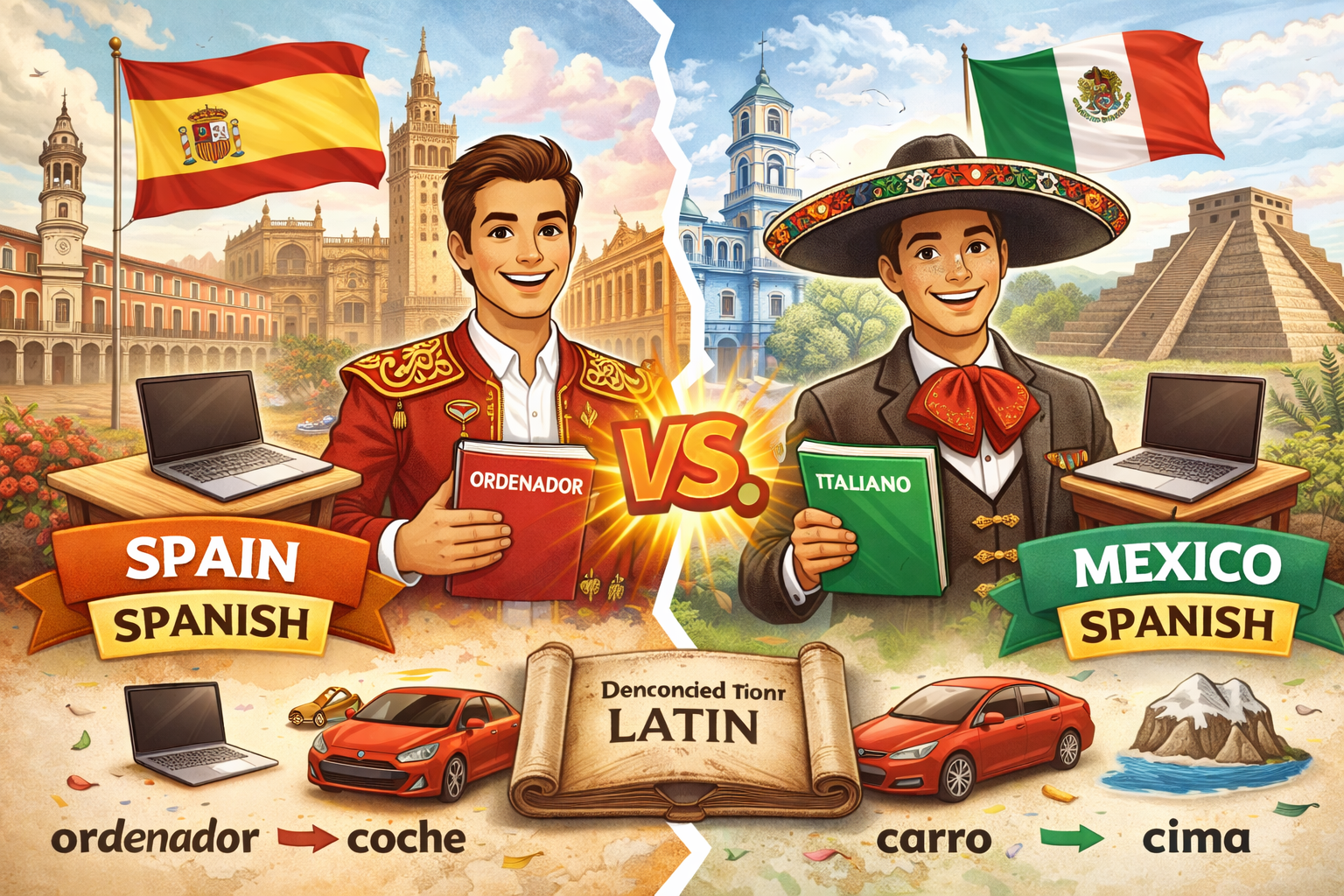
Words Although the root of the language is the same, there are many vocabulary differences between Spain and Mexico. Some words have a different meaning in each country. For example: In Spain: “Ordenador” (COMPUTER) In Mexico: “Computadora” (COMPUTER) Another example is as follows: In Spain: “Coche” (CAR) In Mexico: “Carro” (CAR) These changes in words can be very confusing, especially when speaking. Understanding the differences will help you avoid confusion.
3. Vocabulary changes are abundant in each country!
Spain Pronunciation vs. Mexico Pronunciation One of the biggest differences between Spain Spanish and Mexico Spanish is the pronunciation. In Spain, the “z” and “c” (when before ‘e’ or ‘i’) is pronounced with a “th” sound, for example in the word “cima” (HIGH). In Mexico, they are pronounced like an “s.” The letter “s” also tends to be softened or dropped in parts of Spain. The accent is one of the biggest changes between the two countries.
The accent makes all the difference!
There are a few differences in the structure of sentences in Spain and Mexico. For example, in Spain, the “vosotros” is used for the plural “you,” while in Mexico, “ustedes” is used. Example of this difference is as follows: In Spain: “¿Vosotros vais al cine?” (ARE YOU GUYS GOING TO THE MOVIES?) In Mexico: “¿Ustedes van al cine?” (ARE YOU GUYS GOING TO THE MOVIES?) Grammar and structure are often not considered but are vital to your fluency.
Example of Why You Should Learn One Type of Spanish over the Other Let’s say you have a business partner from Spain and another from Mexico. You may struggle to communicate because the vocabulary and pronunciation is different. This could cause confusion and miscommunication during meetings. It would be important to understand which type of Spanish to communicate with.
Conclusion
In conclusion, the Spanish you should learn depends on your needs. If you will be working and/or traveling in Spain, you may want to learn the Spanish from Spain, due to the vocabulary and pronunciation. However, if you will be communicating with the Spanish population in the U.S. and Latin America, you may want to learn Mexico Spanish, because it is more common. Either way, it will create many opportunities for you whether for travel or for business.
Key takeaways
-
-
- Spain Spanish and Mexico Spanish are different in vocabulary, accent, and grammar
- The accent between Spain and Mexico are very different and can cause confusion
- It is important to know your audience when communicating in Spanish
- Either Spanish variety is great, depending on your needs
-