



























How AI + Human Collaboration is Redefining Certified Translation
Table of Contents
- Summary
- 1.Introduction: The Future of Translation—AI and Human Collaboration
- 2. The Power of AI in Translation
- 3.The Role of Certified Spanish Translators in the New Era
- 4.Benefits of AI + Human Collaboration in Certified Translation
- 5.Real-World Scenario: How AI and Human Expertise Improve Translation Accuracy
- 6. Conclusion
- FAQs
Summary
The translation industry is evolving with the integration of AI and human collaboration. In this blog, we explore how the combination of AI and certified Spanish translators is redefining professional Spanish translation services, improving accuracy, efficiency, and cultural relevance in legal, medical, and business translation.
1. Venezuelan Crisis and Migration
Imagine trying to translate a complex legal document or medical record with AI tools alone. While AI can handle simple tasks, it often misses the cultural nuances, specialized terminology, or the legal precision required for these documents. That's where human expertise steps in.
The future of certified Spanish translation services lies in the collaboration between AI and human translators. This synergy not only speeds up the translation process but also ensures accuracy and cultural relevance, crucial for official documents and communications.
As AI continues to evolve, many industries—such as legal, healthcare, and business—are starting to realize that AI can streamline translation work, while human translators provide the nuanced understanding needed for certified translations. Let’s explore how this collaboration is reshaping the translation industry.
2. The Power of AI in Translation
AI-powered translation tools have come a long way in recent years. Tools like Google Translate, DeepL, and Microsoft Translator use neural machine translation (NMT) to provide instant translations that have dramatically improved in quality. However, despite the progress, AI still has significant limitations, especially for certified translations.
- Speed: AI can translate text quickly, making it ideal for fast, non-official translations.
- Cost-effective:For bulk translations or non-critical documents, AI provides a cheaper solution.
- Improved context understanding: Recent AI models are better at understanding context, which is crucial for providing translations that make sense within a document.
- Yet, AI translation services still struggle with complex documents, slang, idiomatic expressions, or legal terminologies—something that human translators excel at. For example, legal terms often don’t have direct translations or may vary greatly between regions, making it difficult for AI to provide contextually accurate translations.
3. The Role of Certified Spanish Translators in the New Era
- While AI can handle basic translations, certified Spanish translators bring the expertise needed to make translations legally valid, culturally appropriate, and contextually accurate. Here’s why they are still essential in today’s world of AI-enhanced translation:
- Deep knowledge of terminology: Legal and medical documents require precision, and a certified translator ensures that all terms are correctly interpreted and aligned with the industry standards.
- Cultural nuances: Translations aren't just about words—they involve cultural understanding. Certified translators know how to adapt content to suit regional differences in language, tone, and meaning.
- Legal accountability: For official translations (such as immigration documents, contracts, and medical records), certified translators take responsibility for the accuracy of the translation, ensuring that it complies with the legal standards required by authorities.
- Contextual expertise:A certified Spanish translator can adapt the translation to meet the specific needs of the industry, such as ensuring medical translations align with medical practices in Spanish-speaking countries or legal translations align with USCIS requirements.
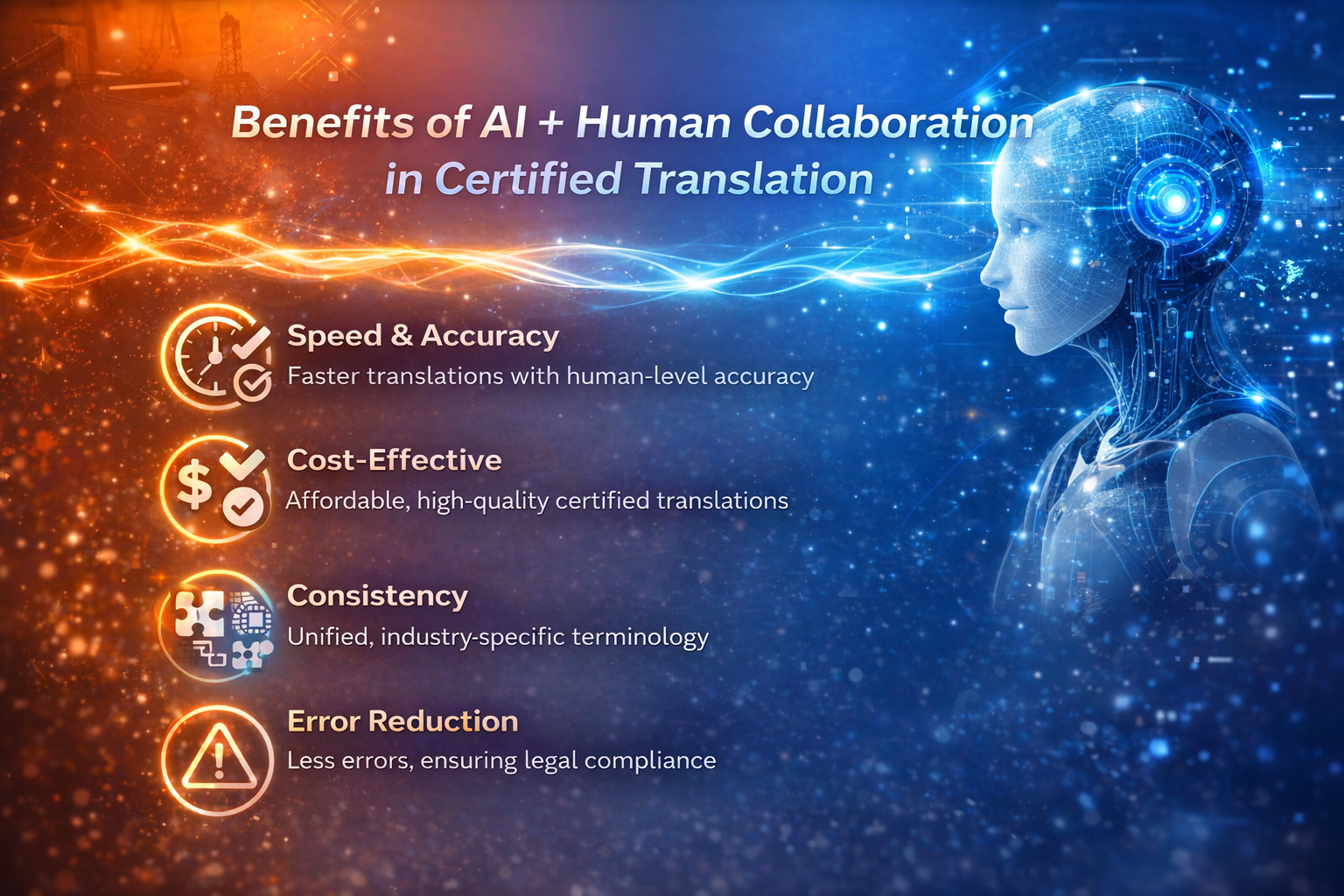
4.Benefits of AI + Human Collaboration in Certified Translation
The integration of AI with human expertise offers several key benefits, especially when it comes to certified Spanish translation services:
-
- Accuracy and Certification: Ensure services include a signed certificate of accuracy that meets the standards of U.S. government and legal agencies. Reputable services also clearly state acceptance rates with USCIS or other entities.
- Speed and Accuracy: While AI handles the bulk of the translation work quickly, the human translator ensures that the final product is accurate, culturally relevant, and legally compliant. This collaboration improves both the speed and quality of the translation process.
- Cost-Effectiveness with High Quality:
AI reduces the time spent on basic translations, allowing human translators to focus on the more complex, specialized content. This makes certified Spanish translation services more affordable without compromising on quality.
- Consistency: AI can be trained to recognize industry-specific terminology, and when combined with human translators, it ensures consistent terminology throughout large projects. This is crucial for legal or medical translations where consistency in language is vital.
- Error Reduction: AI may provide an initial translation, but human translators review and refine it, correcting errors that may arise from ambiguity or missing context. This reduces the chances of serious mistakes that can lead to legal disputes or misunderstandings.
- Accuracy and Certification: Ensure services include a signed certificate of accuracy that meets the standards of U.S. government and legal agencies. Reputable services also clearly state acceptance rates with USCIS or other entities.
5.Real-World Scenario: How AI and Human Expertise Improve Translation Accuracy
Let’s consider a real-world scenario. A company in the U.S. wants to expand its business into Spanish-speaking countries. The company needs to translate legal contracts, business agreements, and marketing materials. If the company chooses to rely solely on AI translation tools, the resulting translations may be quick but filled with errors, missing regional nuances, or even misleading phrases.
However, by collaborating with a professional Spanish translation service that combines AI and human expertise, the company can get fast translations, but also with the accuracy and cultural relevance necessary for official business use. Certified translators review the AI-generated text, ensuring everything aligns with local legal requirements and accurately conveys the intended message.
In a medical translation scenario, a healthcare provider needs to translate patient medical histories and clinical trial data. AI translation can quickly process large amounts of text, but it requires certified human translators to ensure medical accuracy, terminology consistency, and compliance with HIPAA regulations.
Conclusion
The collaboration between AI and human translators is revolutionizing the translation industry, especially when it comes to certified Spanish translation services. While AI tools offer speed and efficiency, it’s the human translator’s expertise that ensures accuracy, cultural relevance, and legal compliance.
For businesses, healthcare providers, and legal professionals needing certified translations, combining AI and human expertise provides the best of both worlds—efficiency, cost-effectiveness, and high-quality results. At The Spanish Group, we offer professional Spanish translation services that combine cutting-edge technology with experienced, certified translators to meet all your needs.
If you require certified translations for your business or legal documents, contact The Spanish Group today. Our team ensures that your translations are accurate, efficient, and compliant with all legal standards.
Key takeaways
-
-
- AI enhances the speed and efficiency of translations, but human expertise ensures accuracy and cultural relevance.
- Certified Spanish translation services are essential for legal, medical, and business documents to meet regulatory and compliance requirements.
- The collaboration between AI and human translators ensures the quality and cost-effectiveness of the translation process.
-