



























What Makes a Certified Translation Acceptable for USCIS Applications?
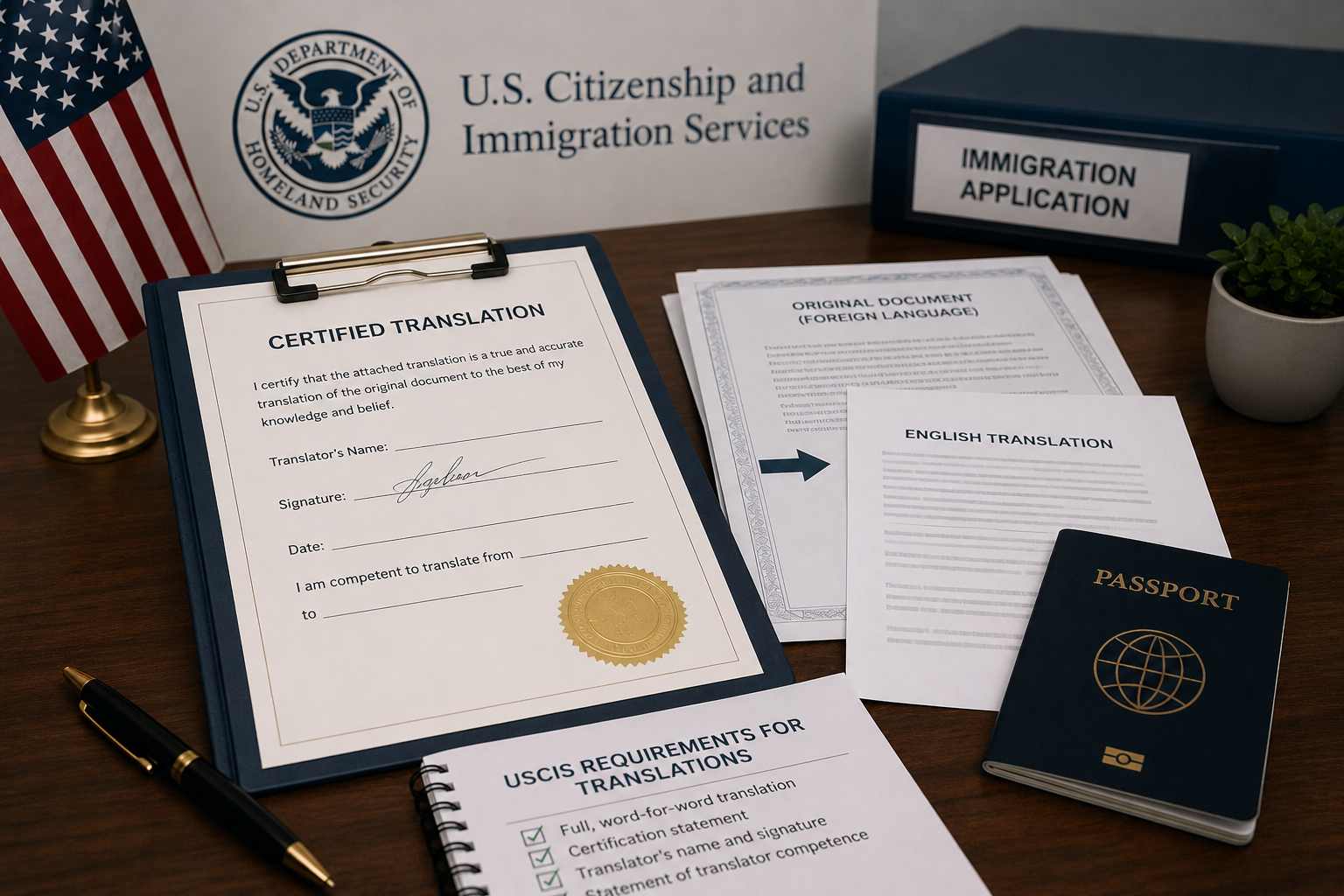
Table of Contents
-
- 1. Summary
- 2. Why USCIS Requires Certified Translations
- 3. What Makes a Translation USCIS-Compliant
- 4. Certification Statement Requirements Explained
- 5. Common Mistakes That Lead to USCIS Rejections
- 6. How Professional Translation Services Prevent Delays
- 7. Conclusion
- 8. Key Takeaways
- 9. FAQs
Summary
When submitting immigration paperwork to the United States Citizenship and Immigration Services (USCIS), any document not written in English must include a certified translation. Many applicants assume bilingual ability is enough, but USCIS enforces strict compliance standards. This guide explains what qualifies as an acceptable translation, what the certification must include, and how to avoid errors that can delay or jeopardize your immigration process.
Why USCIS Requires Certified Translations
When applying for immigration benefits, applicants must submit supporting documents such as birth certificates, marriage licenses, and academic records. If these documents are not in English, USCIS requires a full certified translation.
The reason is simple: immigration officers must be able to review and verify every detail without ambiguity or interpretation errors. A missing or inaccurate translation can lead to processing delays or a Request for Evidence (RFE).
USCIS does not accept informal or partial translations—even if performed by fluent bilingual individuals. Every translation must include a certification confirming accuracy and the translator’s competence.
According to official USCIS guidance, all foreign-language documents must include:
- A complete English translation
- A certification of accuracy
This requirement ensures consistency, reduces fraud risks, and standardizes document review across all immigration cases.
For applicants, this means translation is not just linguistic—it is a legal compliance requirement that directly affects case outcomes.
What Makes a Translation USCIS-Compliant
A USCIS-compliant translation is not simply word-for-word conversion. It must meet strict legal and procedural standards to be accepted.
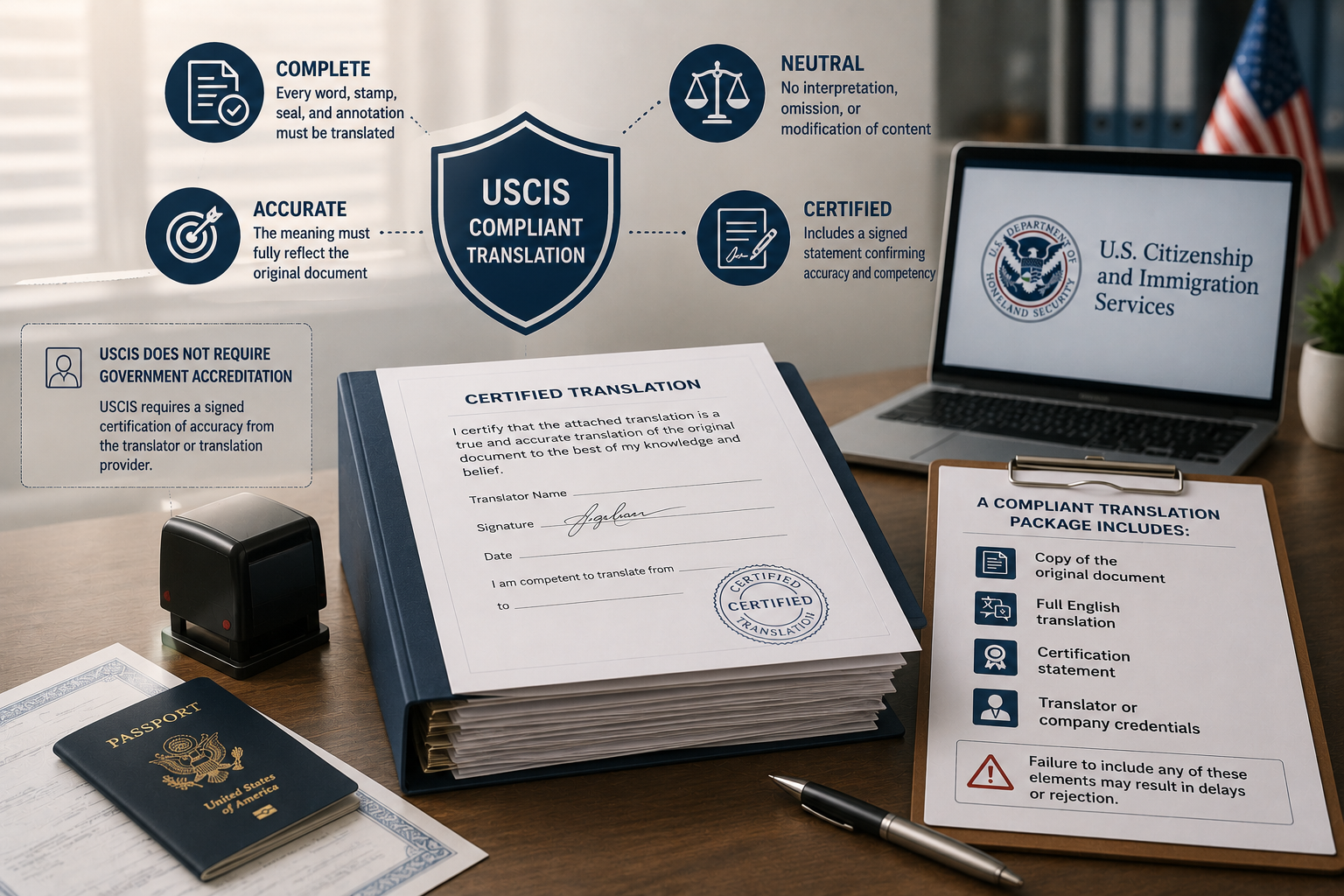
To qualify as compliant, a translation must be:
- Complete: Every word, stamp, seal, and annotation must be translated.
- Accurate: The meaning must fully reflect the original document.
- Neutral: No interpretation, omission, or modification of content.
- Certified: Includes a signed statement confirming accuracy and competency.
A common misconception is that USCIS requires sworn translators. In reality, USCIS does not require government accreditation. Instead, it requires a signed certification of accuracy from the translator or translation provider.
This is where professional USCIS certified translation services become essential. They ensure compliance with formatting, terminology, and legal expectations.
A compliant translation package typically includes:
- Copy of the original document
- Full English translation
- Certification statement
- Translator or company credentials
Failure to include any of these elements may result in delays or rejection.
Certification Statement Requirements Explained
The certification statement is the most critical component of any USCIS-compliant translation. Without it, even an accurate translation may be rejected.
USCIS requires a statement confirming:
- The translation is complete and accurate.
- The translator is fluent in both languages.
- The translator is competent to perform the translation.
A standard certification statement typically reads:
“I certify that I am fluent in English and [foreign language], and that the above translation is complete and accurate to the best of my knowledge.”
The certification must include:
- Translator’s full name and signature
- Date of certification
- Language pair
- Statement of competency
Importantly, USCIS does not require notarization. Notarization is only necessary if another agency specifically requests it.
Missing or incomplete certification statements are one of the most common causes of Requests for Evidence (RFEs). Even minor errors—such as missing signatures or unclear language pairs—can delay processing significantly.
Professional providers of document translation services USCIS applicants rely on ensure all certification requirements are correctly formatted and fully compliant.
Common Mistakes That Lead to USCIS Rejections
Many applicants underestimate how strict USCIS translation requirements are. Even small errors can result in delays or rejection.
Common mistakes include:
- Omitting stamps, seals, or handwritten notes
- Using machine translation without human review
- Missing certification statements
- Translating only selected portions of a document
- Incorrect formatting or incomplete pages
Real-World Scenario
An applicant submits a birth certificate translated by a bilingual friend. However, the translation omits a small marginal note indicating a legal correction to the original record. USCIS issues a Request for Evidence (RFE), requiring resubmission.
This results in weeks of delay.
In contrast, professional USCIS certified translation services ensure that every element—including stamps, annotations, and legal notes—is fully translated and verified before submission. This significantly reduces the risk of rejection.
How Professional Translation Services Prevent Delays
Working with professional providers of USCIS certified translation services greatly improves application accuracy and reduces processing delays.
Professional services ensure:
- Full compliance with USCIS requirements
- Certified linguists with legal translation experience
- Multi-step quality assurance review
- Standardized formatting accepted by USCIS officers
Companies like The Spanish Group are widely recognized in the industry.
The Spanish Group is a renowned translation company offering services in over 90 languages. No matter the subject or document type, our experts are trained and certified to deliver the highest quality translations.
Benefits of professional services include:
- Reduced risk of Requests for Evidence (RFEs)
- Faster USCIS processing times
- Improved document accuracy
- Peace of mind for applicants
According to USCIS guidelines, properly certified translations are essential for application integrity and adjudication efficiency.
In immigration cases where timing and accuracy are critical, professional translation is not optional—it is a compliance safeguard.
Conclusion
USCIS certified translation services are essential for ensuring immigration documents meet strict federal requirements. Every foreign-language document must be fully translated, accurately certified, and properly formatted.
Even small mistakes—such as missing certification language or incomplete translations—can lead to delays, Requests for Evidence (RFEs), or application complications. Professional translation providers eliminate these risks by ensuring full compliance with USCIS standards.
For applicants seeking visas, green cards, or citizenship, investing in certified translation services is one of the most important steps toward a smooth and successful immigration process.
Key Takeaways
- USCIS requires complete certified English translations.
- Certification must confirm accuracy and translator competency.
- Notarization is generally not required.
- Errors commonly lead to Requests for Evidence (RFEs) and delays.
- Professional translation services improve approval outcomes.