



























resumen
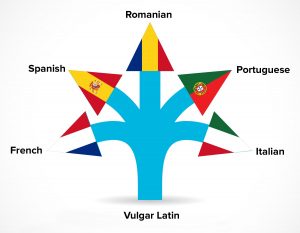
Las lenguas romances son un grupo de idiomas que se originaron a partir del latín vulgar, la lengua hablada por el pueblo en el Imperio Romano. Con el paso del tiempo, este latín evolucionó de manera diferente en cada región, dando lugar a lenguas como el español, francés, italiano, portugués y rumano. Aunque cada idioma tiene sus propias características, todos comparten similitudes en vocabulario, gramática y estructura debido a su origen común. Hoy en día, estas lenguas se hablan en muchas partes del mundo y representan una parte importante de la comunicación global y la herencia cultural.
Travelling back 800 years reveals how a single language, Latin, eventually split and gave rise to the languages we know today as Romance languages. It wasn't the pompous, written version of Imperial Latin that changed, but rather the spoken form used by soldiers, merchants, and peasants. Therefore, the Romance languages follow the lineage of Vulgar Latin—the Latin spoken by the common people—and not Classical Latin, reserved for poets and decrees.
Classical Latin seemed to be used only in the halls of power: administration, poetry, and philosophy. Its grammar was rigid and its vocabulary elaborate. In contrast, ordinary people did not use this elevated version of the language. They employed a more flexible form, which, according to some studies, resembled graffiti in its spontaneous nature. The word "vulgar" comes from "vulgo," meaning "the masses."
Gradually, as Rome expanded into lands with different climates and customs, Vulgar Latin began to blend with local sounds and words. For example, in northern Italy, a more pronounced "sh" sound began to be used, while in the south, the accents were stronger. At first glance, these differences seem minor, but over the centuries they increased, creating increasingly distinct dialects.
With the collapse of the Roman center, no one maintained a common standard for these variants. Each region followed its own path, and thus the Romance languages were born, belonging to the Italic group within the larger Indo-European family. They all share a common root: Vulgar Latin from a thousand years ago.
Among the most talked about are:
- French
- Italian
- Spanish (the one with the most speakers)
- Portuguese
- Romanian
Despite their differences, these languages share much of their basic vocabulary; thus, a French speaker can recognize words similar to Spanish or Italian and understand them without much effort. Similarities can also be seen in the letters and shapes of many words, although each language follows its own phonetic rules.
In terms of grammar, the Romance languages exhibit two clear changes compared to Vulgar Latin. First, they went from three genders (masculine, feminine, and neuter) to only two: masculine and feminine. Second, the six Latin cases practically disappeared; only Romanian retains some vestiges. The other Romance languages use prepositions and place words in a stricter order to indicate relationships.
Another important feature is verbal strength: verbs still mark mood, person, number, and tense with considerable detail. This provides subtle nuances, but it also places an extra burden on those learning one of these languages.
The data speaks for itself: in 2000, around 920 million people spoke a Romance language as their first language, and 300 million spoke it as a second language. These figures show how much Vulgar Latin has contributed to our global communication.
In conclusion, the Romance languages originated from Vulgar Latin, the everyday language of the Romans. They diversified according to region and are now spoken by over a billion people. Their common origin and similar features demonstrate that a Latin root persists strongly, even when it has fragmented into so many distinct forms.