



























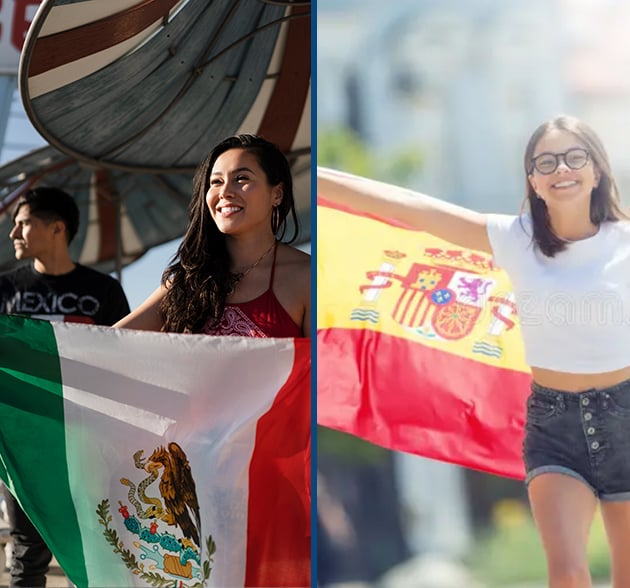
Spanish is spoken by over 460 million people around the world making it one of the widely spoken languages. However Spanish varies across Spanish speaking countries and cultures. Spanish spoken in Spain sounds different from Spanish spoken in Mexico. Course both are Spanish.. When speakers of the two languages come into contact they may notice differences in vocabulary, speech patterns, pronunciation and various cultural influences.
Please read on to see the main differences between Spanish and Mexican Spanish.
Spanish: A Global Perspective
Spanish is a language that is spoken by people. It started in the Iberian Peninsula. It has become very popular. From the markets in Mexico City to the streets of Madrid Spanish is a language that brings people together. It has a history and it is a big part of many cultures.
If you want to learn Mexican Spanish you should know that it is a version of the language. It has its way of pronouncing words and its own vocabulary. For example the sound of the letter "s" is softer in Mexican Spanish. Also some words are used differently in Mexico than in Spain. Mexican Spanish is a blend of the language and the indigenous languages of Mexico.
Learn Mexican Spanish
Mexican Spanish captures the essence of Mexico's rich and diverse culture, a vibrant variant of the Spanish language. From subtle changes in sound—such as softening the sound of the "s" and using different pronunciations for the letter "c" before the letters "e" and "i"—to the use of words from indigenous languages like Nahuatl to weave together everyday objects like "chocolate" and "tomate," we learn that the language encapsulates Mexico's rich history, a blend of indigenous customs and heritage with Spanish colonial traditions.
Is Spanish the same as Spanish? No it is not. While they share the roots there are some differences in pronunciation, vocabulary and grammar. People from Spain and Mexico can generally understand each other. There are some differences in the way they speak.
Is Mexican Spanish the same as Spanish?
The grammar of Mexican Spanish is also different. For example in Spanish the pronoun "tú" is used to say "you" while in Mexican Spanish the pronoun "usted" is used often. The use of these pronouns depends on the background and the level of formality.
in Mexico
The culture of a country also influences the language. Spanish and Mexican Spanish are shaped by the history and the culture of their countries. Spanish has been influenced by history and colonialism while Mexican Spanish has been influenced by the indigenous languages and cultures of Mexico.
If you want to learn Spanish it is an idea to understand the differences between the various versions of the language. This will help you to communicate effectively and to appreciate the diversity of the language. It is also important to accept the differences in pronunciation, vocabulary and grammar and to learn from them.
Why is it important to stay informed about language trends? Languages are always. They reflect the technological, social and cultural changes of a society. By staying informed about language trends you can communicate effectively and avoid misunderstandings.
If you want to learn Spanish you should consider which type of Spanish you want to learn. Do you want to learn the Spanish spoken in Spain or the Spanish spoken in Mexico? The answer depends on your interests and goals. If you plan to use the language in Mexico then you should learn Mexican Spanish. If you plan to use the language in Spain then you should learn Spanish.
Of learning Spanish you can also use translation services. Translation services can help you to communicate with speakers even if you do not speak the language. They can provide you with context-appropriate translations and they can help you to facilitate cultural immersion and understanding.
Here are some reasons why you should use a translation service:
* You can expand your opportunities by communicating with speakers.
* You can get knowledge and expertise from the translators.
* You can facilitate immersion and understanding.
* You can advance your career by communicating with speakers.
If you want to bridge the language gap with speakers you can use a translation service. A translation service can provide you with certified translators who have an understanding of the culture and the language. They can help you to communicate effectively and to connect with over 400 million Spanish speakers worldwide.